Pest Control Services · By Kai Horner, owner of Kekoa Pest Control · Published · Updated
Plenty of good companies exist at both ends of this market, and plenty of good people work for large ones. So this is not a case against big firms. It is a plain list of what changes with size, written by a one-owner business that knows its own limits. Our pest control in Tempe page explains how Kekoa works if you want the local detail.
EPA's Citizen's Guide makes the same point in a different way. It says to judge a pest control service with the same care you would use to choose any professional. Size does not answer that question. Conduct does.
Local vs national pest control: what actually differs
| Factor | Owner-operated | National or large regional |
|---|---|---|
| Who comes to the house | The owner, in most one-person shops | Whoever is assigned, sometimes a regular person |
| Who answers questions | The person who did the work | An office, then the field person |
| Capacity on a busy day | Small. One person, one route | Larger. More people can be moved around |
| Hours and coverage | Limited, tied to one schedule | Often longer, with more phone coverage |
| Service area | Usually a home region | Can follow you across cities and states |
| Range of services | Depends on the owner's skills and gear | Often broader, with special equipment |
| Consistency | Same habits, with one person's blind spots | Written procedures, varying by branch |
| Paperwork | Often simple | Often formal, with portals and written terms |
| When something goes wrong | Direct line to the decision maker | Formal process and layers of review |
Every row has a fair case on both sides. A property manager with sites in three states needs one thing. A retiree who wants to know who is walking through the house needs another.
Where a small pest control company has the edge

The main advantage is continuity. One person who has walked your yard every month remembers the weep hole by the gate and the ant trail that returns after rain. Nothing has to be handed off, because there is no one to hand it to.
- Direct answers. You ask the person who did the work.
- Accountability. The owner's name is on it and there is no one else to blame.
- Fewer sales layers. Kekoa's own profile says "No sales gimmick," and that is easier to keep up with no sales floor.
- Flexibility on small things. An owner can use judgment without asking a manager.
Those are general strengths of the model. Customers of this business report a day-before reminder, punctual arrival, clear explanations of what he is doing and rates that have not been raised on one long-time customer. Those are individual reviews, not promises.
Where one person falls short, and a larger company helps
This is the section many small-business posts leave out. A family-owned exterminator working solo has hard limits, and you should weigh them.
- Limited capacity. One person can only be in one driveway. In a busy week you may wait.
- No backup. Illness, vacation or a vehicle breakdown can move your visit.
- Shorter hours. Kekoa keeps set hours and closes Sunday.
- Size limits. A large multi-building property may be more than one person should take on.
- Narrower range. Some jobs need equipment or staffing that a solo owner does not carry.
- Less formal paperwork. Large firms often publish detailed service terms. With any company, get what matters in writing.
- Records tied to one person. If a solo owner retires or sells, your service history goes with that decision. Keep your own copies of what was applied and when.
If you run a large commercial property, need service on a Sunday or want one contract across many cities, a bigger operation may simply suit you better. Saying so costs us nothing, and it may save you a bad fit.
Quick fit check
Match your own situation to the line that fits. If you land on both sides, the top line on your list is the one to weigh most.
| What you need most | Size that usually suits it |
|---|---|
| The same person on every visit | Owner-operated |
| A direct line to whoever sprayed | Owner-operated |
| Help on a Sunday or outside set hours | Larger company |
| One agreement across several states | Larger company |
| Several buildings at once | Larger company |
| A single house with a routine plan | Either, so compare scope |
Doorstep sales: what protects you with a company of any size
A contract signed at your front door follows the same rules whoever sent the seller. Before you agree to anything on the step, know the basics.
The Federal Trade Commission's Cooling-Off Rule lets you cancel many sales made at your home, if they run $25 or more, until midnight of the third business day after the sale. Saturdays count. Sundays and federal holidays do not. The seller has to tell you about that right, hand you two copies of a cancellation form and give you a dated contract or receipt showing the seller's name and address. Not every sale qualifies, so read the paperwork you are given.
Arizona adds a useful check. Rule A.A.C. R3-8-310 has a licensed pest business show its name and license number on proposals and contracts, and on marked service vehicles. Take that number to the state lookup before the three days run out. Then read the term, the renewal wording and the way to stop service, none of which get easier to change later.
Choosing a pest control company: questions that work for any size

EPA's guide offers a solid framework. These are adapted from it, and they apply equally to us.
- Is the business licensed? Arizona's Department of Agriculture licenses pest management businesses through its Pest Management Division (A.A.C. R3-8-201). Look up any company at opm.azda.gov/PCBusSearch.php.
- Will they discuss the plan? A company should be able to name the pests, the active ingredients, the method, the non-chemical options and how to prevent repeat problems.
- What is the track record? EPA says not to rely on the salesperson. Ask neighbors, and call the state agency about complaints.
- Can they show proof of insurance? EPA suggests asking to see it on paper.
- Who will actually come to my home? Ask this one directly.
- What is the term, and how do I cancel?
- What happens if pests return between visits? Get the answer in writing.
How Kai thinks about this question
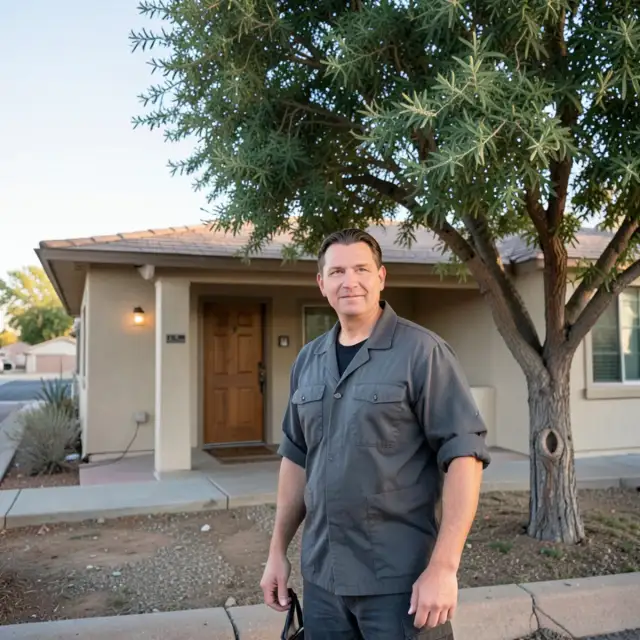
Kai is not trying to win every customer. Kekoa is family owned, owner operated and has been at it since 2022, with one person doing the work. He would rather you hire whoever fits than sign up for the wrong reason. If a job is beyond what one person can do well, he will say so on the phone.

For a typical single-family home, the fit is usually simple. Reviews describe monthly pest control inside and out, a list of chemicals left at those visits and a chance to ask questions at the door. The base is in Tempe, with regular work around nearby cities such as Gilbert.
Reviews are a fair place to start for any company. Read the recent ones, watch how the business responds, and ask for specifics.
Want to compare? Call (209) 563-1650, ask your questions, and hear straight from Kai whether he is the right fit.
Sources
About the author
Kai Horner owns and runs Kekoa Pest Control, a family-owned pest and weed control business based in Tempe, AZ, serving the East Valley since 2022. More about Kai