
Bee & Wasp Removal · By Kai Horner, owner of Kekoa Pest Control · Published · Updated
The phrase "killer bees" does a poor job here. It suggests a roaming threat you can pick out of a crowd. The Arizona situation is quieter and more practical. Wild honey bees nest in the same walls, valve boxes and sheds you use, and they defend those nests harder than the bees people picture. For anything already nesting on your property, start with our bee and wasp removal overview.
Africanized bees: Arizona's wild honey bees explained
University of Arizona Extension describes Arizona's wild honey bees as hybrids of the western honey bee with other subspecies, including the East African lowland honey bee. Three facts follow from that.
- You cannot see the difference. Only genetic testing reveals a colony's lineage.
- They defend more. Africanized bees may hold a larger alarm zone, and they respond faster and in larger numbers.
- They are less predictable. A colony can seem calm, then react to something small. Extension also says they swarm and relocate more often under stress.
A single bee on a flower or at the pool edge is not a concern unless you are allergic. Extension says foraging bees are looking for water, nectar or pollen, and earlier University of Arizona guidance says a lone forager stings only if trapped or threatened.
Honey bee or wasp? Check before you worry
The Sonoran desert region holds more than 1,000 bee species, University of Arizona Extension says, and most bees and look-alikes are harmless or useful. Extension's first step is correct identification, and a few features sort out the insects most often seen around a house.
| Honey bee | Yellowjacket | Paper wasp | |
|---|---|---|---|
| Size | ½ to ¾ inch | ½ to 1 inch | 1 to 1¼ inches |
| Body | Black or dark brown, densely hairy | Robust, smooth, jagged yellow pattern | Long and slender, narrow waist, dark wings |
| Legs | Stout, often with yellow pollen balls | Slender, yellow | Long, slender, yellow |
| Sting | Each worker stings once and leaves the stinger | Can sting multiple times | Can sting multiple times |
The nest differs too. Paper wasps build open paper combs under eaves. Africanized bees are honey bees, so a table like this tells you the insect, never the lineage.
Swarm or colony: which one do you have?
These are two different situations, and they call for different responses.
| Resting swarm | Established colony | |
|---|---|---|
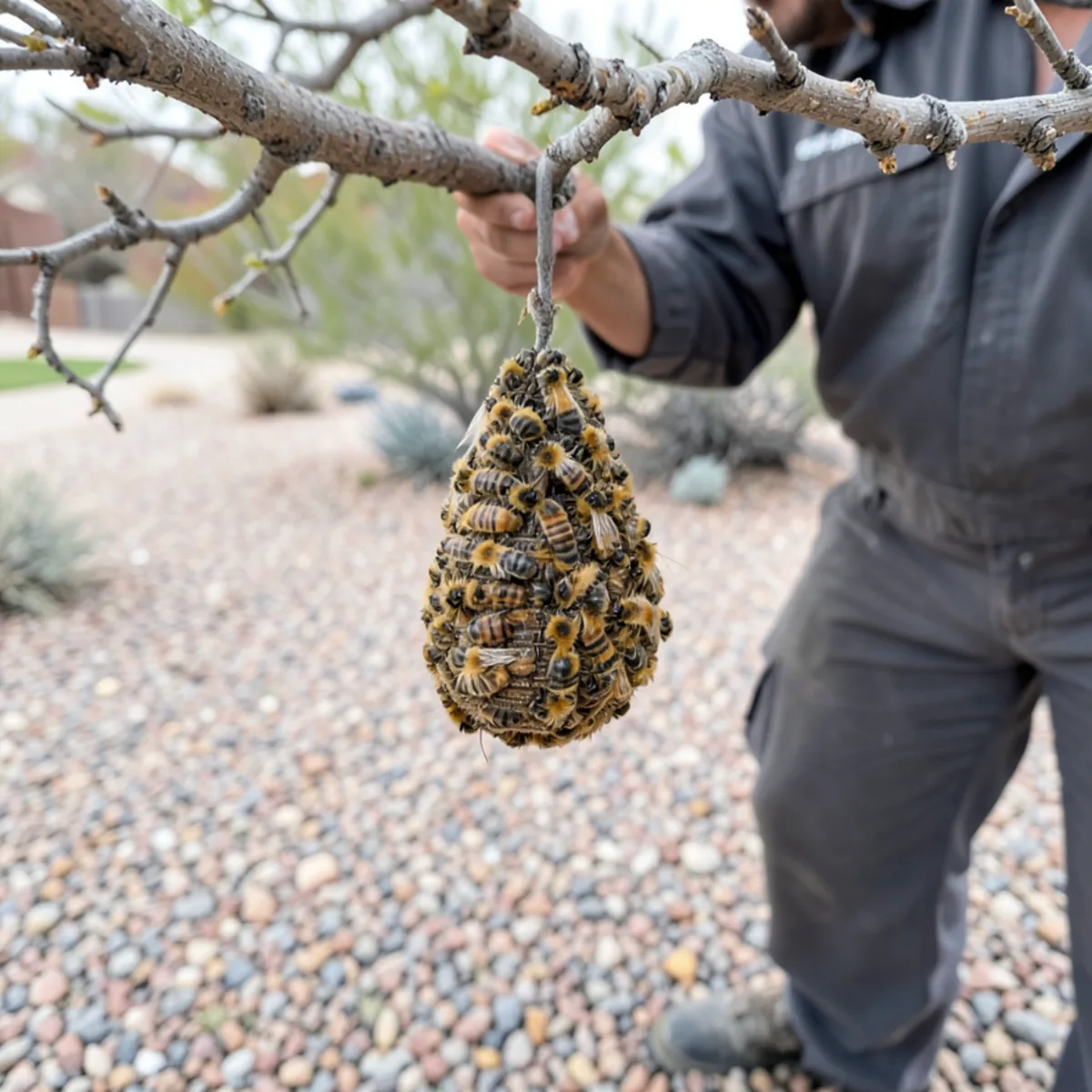
| What you see | A cluster on a branch, wall or fence | Bees flying steadily in and out of a cavity |
| Mood | Generally not defensive | Protective, more so once brood is being reared |
| How long | Usually moves within 24 to 72 hours | Stays and grows |
| What to do | Keep people away, have it removed if it is in the way | Keep people away, have it removed |
Two details help from a distance. Extension says swarming bees carry no yellow or orange pollen on their hind legs, and they will not be moving in and out of a cavity. A swarm in a spot with little foot traffic can be left alone behind caution tape until it moves on. Disturbing one breaks up the cluster and scatters bees around the yard, so do not hose it or shake the branch.
A swarm can still sting if disturbed. A small new colony may seem docile and become more defensive with age, so University of Arizona guidance says not to ignore one just because it has been quiet so far.
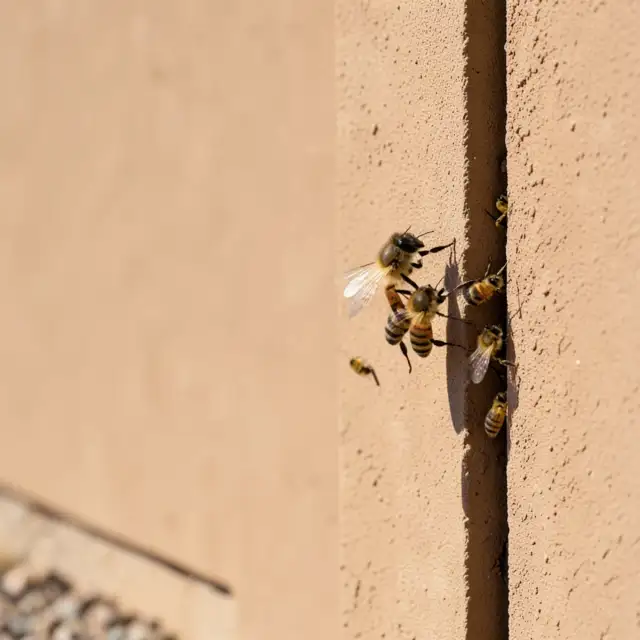
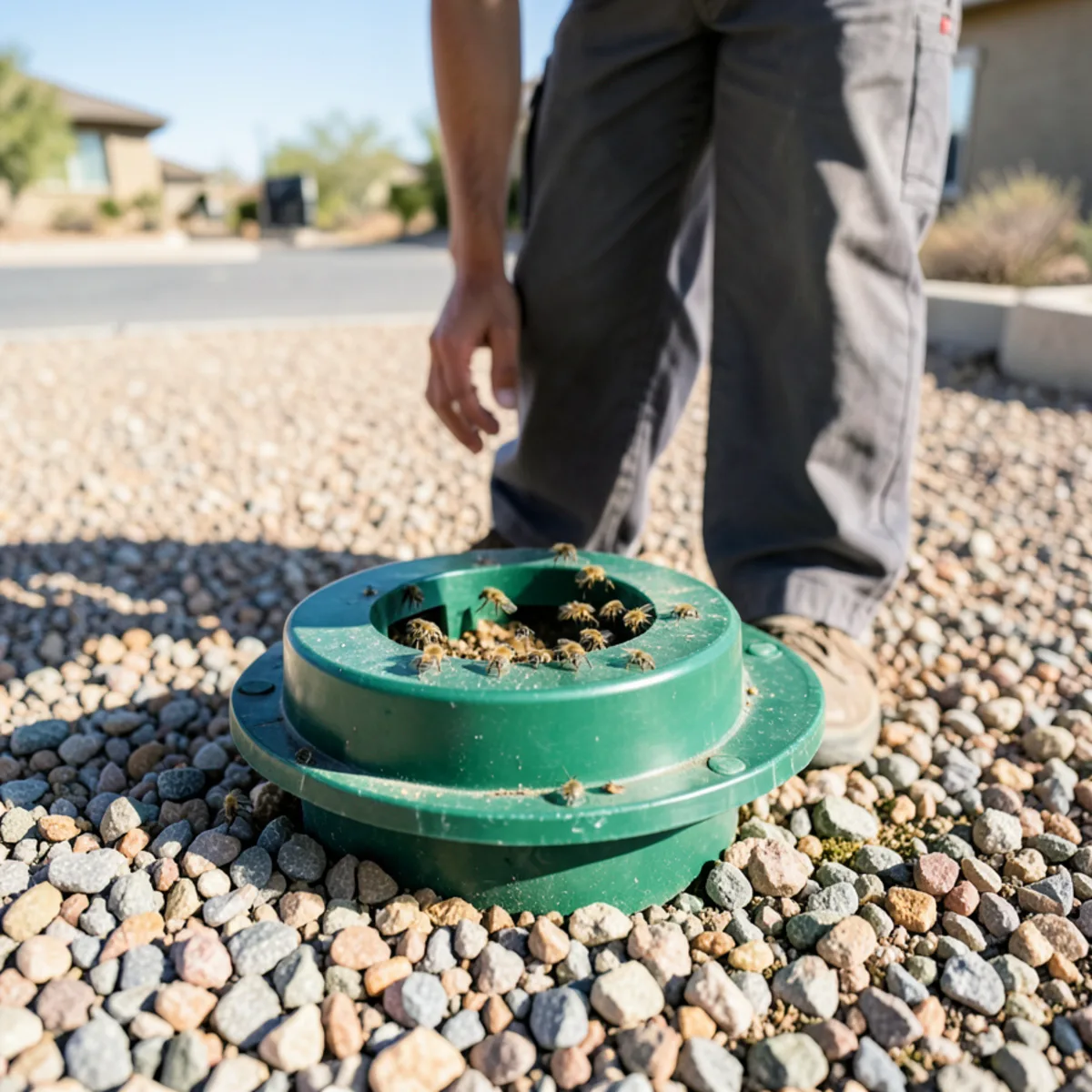
Colonies choose enclosed spaces. Extension's list covers block walls with hollow cores, wall voids, attic and crawl spaces, and irrigation boxes set in the ground. Older guidance says to look for many bees using an opening such as a wall crack, a hole in the ground or a water valve cover.
What sets off a bee attack in Arizona?
Most stinging incidents begin with an accidental disturbance. University of Arizona Extension names the usual triggers.
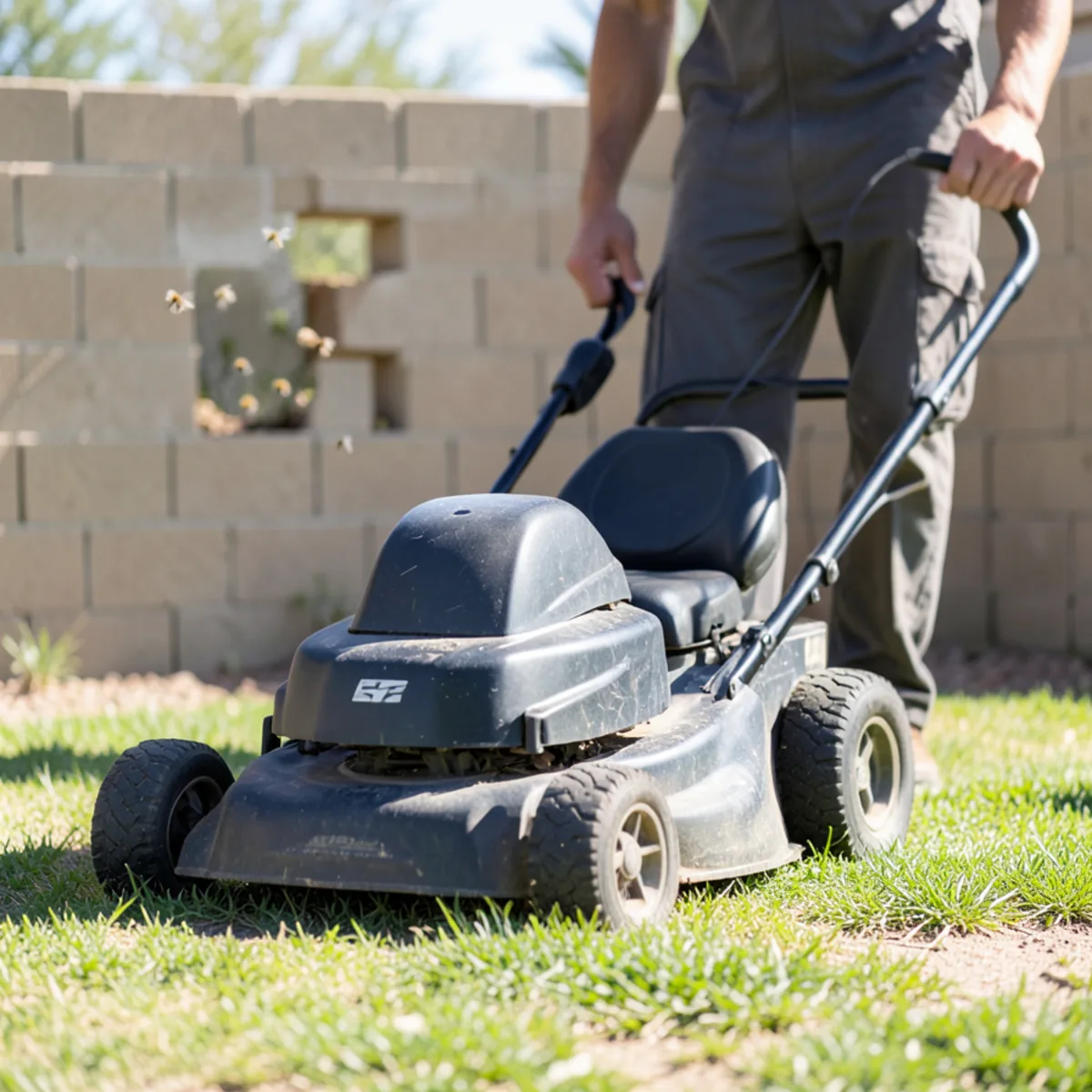
- Sound and vibration from landscaping equipment, such as mowers, blowers and trimmers.
- Physical disturbance, including being hit, poked or sprayed with water.
- Smells such as gasoline, kerosene, some pesticides, paint thinner and even some hair spray.
- Cloudy, overcast days, and cool mornings before the bees can fly.
USDA's Carl Hayden Bee Research Center adds light-colored clothing and caution around noisy equipment, and warns against tying up animals near a nest. Keep this in mind before you start the mower by a wall with bee traffic.
Do not try to deal with a colony yourself. University of Arizona guidance is firm: never shoot at, throw rocks at, pour gasoline on, burn or spray a colony. Extension does not recommend pesticide sprays on swarms or colonies.
If bees come after you
Know these steps before you ever need them. They come from University of Arizona Extension, USDA and CDC.
- Cover your face and head with your hands or shirt, and look through your fingers.
- Run to the nearest building or car, get in and shut the door.
- If no shelter is near, keep going at least 240 yards, the length of two football fields.
- Do not swat or flail. Crushed bees and movement bring more bees.
- Never jump in a pool or canal. Bees hover and wait for you to surface.
- If you cannot move, crouch, cover your head and stay as still as you can.
- Once safe, scrape or wipe off stingers. CDC says never to squeeze them or use tweezers.
Do not try to rescue someone under attack without protective gear. Tell them to run, and call 911. Call 911 for any trouble breathing or severe reaction. For advice on stings, Poison Help is 1-800-222-1222.
CDC's first aid for workers covers the rest: have someone stay with the stung person to watch for an allergic reaction, wash the site with soap and water, apply ice for swelling and do not scratch. CDC also says anyone with a history of severe reactions should carry an epinephrine auto-injector and wear a medical ID.
Bee safety around your own property
Prevention is mostly about removing homes and water. Extension's list for discouraging nesting is practical.
- Fill holes of ⅛ inch or larger in walls and structures with voids, using a good sealant.
- Put mesh over rainspouts, chimneys and water meter boxes.
- Remove overturned pots and other shelter from the yard.
- Fix leaks at taps and irrigation lines.
- Never seal a hole while bees are still using it.
How Kai handles a bee call
Bee calls start on the phone, with distance. Tell Kai where the bees are, whether they are going in and out of something, and who is close by. Keep people and pets away while you wait.
Extension says that after a colony is removed, the cavity must be cleaned out and sealed or new swarms will move in, so ask what happens to the comb and the opening before work starts. Its advice is to use an experienced beekeeper who can relocate the bees, or a pest management professional using an integrated approach. The Arizona Beekeepers Association lists beekeepers who may help, and a local beekeeper is often a good first call for a clean swarm on a branch.
The job gets harder as the bees get harder to reach. A valve box lifts open. A colony behind stucco or inside hollow block may mean opening the wall to get at the comb, and leaving comb behind invites the next swarm. Ask anyone you hire how they will reach it, who repairs the opening and how you avoid hosting the next swarm.
Our page on Africanized bee removal covers the job in more detail, and Kai will give you a straight answer on when he can come.
Bees turn up all over the East Valley, from Mesa neighborhoods to the desert edge around Apache Junction. If you can see a steady line of them from a safe distance, call (209) 563-1650 and stay back until you have talked to Kai.
Sources
About the author
Kai Horner owns and runs Kekoa Pest Control, a family-owned pest and weed control business based in Tempe, AZ, serving the East Valley since 2022. More about Kai